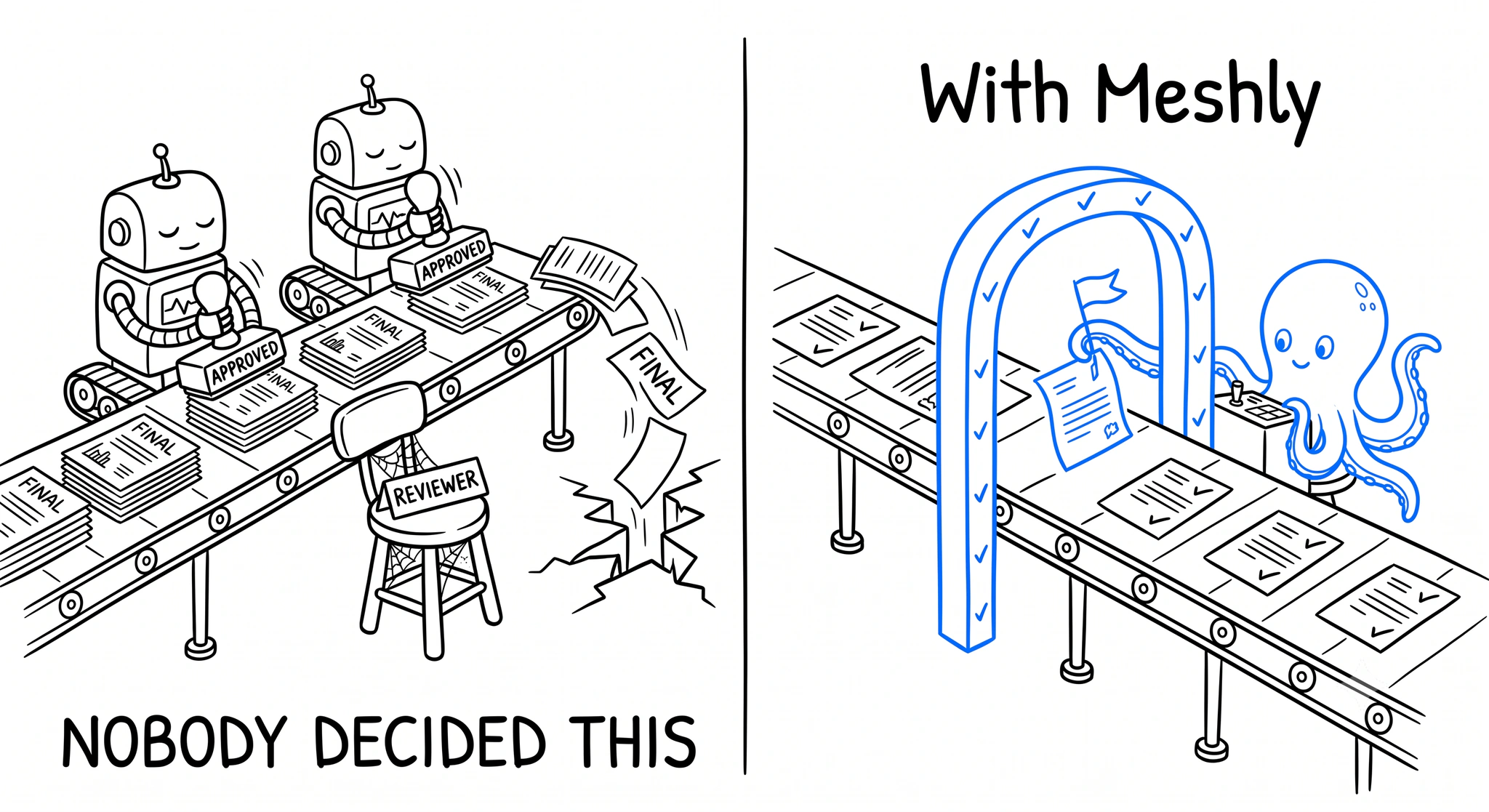
Finance teams didn't decide to adopt AI in 2026. They got AI inside things they already owned. It arrived in the close software, the contract tooling, the billing platform, the rev rec module. Nobody signed a decision memo. It shipped in a release note.
So the question stopped being whether to run AI in finance. The question is what checks it. When a model or an agent touches a number, something has to establish that the number is still right, still traceable, and still defensible ninety days later.
For most companies the honest answer today is a person, sometimes, if they had time.
That's the gap an AI verification layer for finance fills.
What a verification layer actually is
An AI verification layer sits above your finance systems and continuously checks whether they still agree about the same transaction. It runs on its own. Nobody opens a dashboard, nobody kicks it off, nobody works a queue to make it run.
When the contract, the CRM, the billing system, and the ledger stop matching, it catches the divergence, explains what moved, and records where the value came from and who or what changed it.
It is not a review process. It is not a person double-checking work. It is infrastructure that runs whether or not anyone is looking.
Why finance needs one now
AI arrived inside software finance teams already owned. The close tool, the contract tool, the billing platform, the rev rec module.
The people who used to catch errors by hand are being cut for efficiency at the same moment. So the checking that used to be done by headcount is not being done by anything.
That is the gap. Not a tooling gap. A control gap. COSO, which defines the internal control framework nearly every public company runs on, published its own guidance on this in February 2026. And in June, FEI's Committee on Corporate Reporting, controllers and chief accounting officers from Fortune 100 companies, published an AI Framework for Internal Control Over Financial Reporting because SOX and COSO were not built for this.
Both describe how to control the AI you run. Neither gives you the mechanism to do it.
What it actually does
Most tools that claim to reconcile systems need you to tell them the schema first. Every contract is structurally different, so that breaks immediately.
A verification layer works the other way.
It learns the structure. It infers the shape of your data from the records themselves, with no predefined schema, and tracks how that shape changes over time. A renamed field, a disappeared field, a changed type.
It matches the same thing across systems. Deterministic entity resolution, so the deal in the CRM and the obligation in the contract are known to be the same deal rather than guessed to be.
It watches for drift statistically. Always on, not a scheduled report. It flags the moment two systems start disagreeing, not at close.
It records lineage on every value. Actor, source, and timestamp, whether a person or an agent made the change, so any number traces back to where it came from.
A person enters at the end, on the exceptions, to make a judgment call. Not to do the checking.
What to ask of the AI you're already running
You don't need a position on AI in finance to ask these. You need someone to ask them before the audit does.
- If an AI tool produced a journal entry, can you reproduce that entry from the same inputs in ninety days?
- When your contract source, CRM, and billing system disagree about a deal, which one did the AI read?
- When these tools fail in your workflow, do they refuse, or do they return a confident wrong answer?
- If an auditor asked tomorrow for a packet on your AI-touched controls, what would you hand them, and how long would it take to assemble?
The model underneath is swappable. You stay multi-model, because the frontier moves every month. The verification layer is what lasts.
It does not do the work. It makes the work provable.